
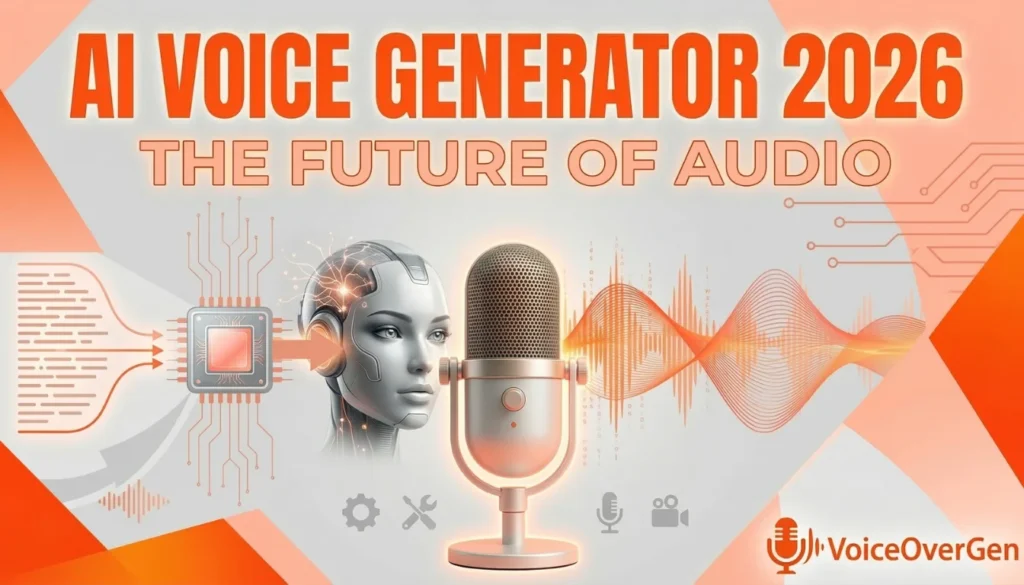
Voice technology has changed dramatically over the past few years. What used to sound mechanical and robotic has evolved into speech that often feels natural, expressive, and close to human narration. AI voice generators are now used across industries including media production, marketing, education, software development, and accessibility technology.
Instead of recording voiceovers in a studio, creators can now transform written scripts into professional sounding narration in seconds. AI voice generators rely on advanced machine learning models trained on large datasets of human speech. These systems learn how people speak, including tone, pacing, pronunciation, and rhythm, allowing them to generate highly realistic audio from plain text.
Because of this capability, AI voice generation has become a powerful tool for content creators, businesses, and developers who need scalable audio production. Whether someone is producing YouTube videos, building e-learning courses, creating product demos, or developing voice enabled applications, AI voice generators make audio creation faster and far more flexible.
This guide explains what an AI voice generator is, how the technology works, the advantages it offers, and where it is being used in the real world in 2026.
What Is an AI Voice Generator
An AI voice generator is a software system that converts written text into spoken audio using artificial intelligence based speech synthesis models. These tools are often built on modern neural text to speech technology that replicates the patterns found in natural human speech.
Earlier generations of text to speech software relied on rule based systems or stitched audio fragments. While functional, those methods produced speech that sounded monotone and artificial. Modern AI voice generators instead use deep learning models trained on thousands of hours of recorded human voices. These models analyze how people pronounce words, emphasize sentences, and adjust pitch while speaking.
When a user enters a script into an AI voice generator, the system interprets the text and produces audio narration that sounds fluid and conversational. Many platforms also allow users to adjust speaking style, speed, emphasis, and emotion to better match the intended tone of the content.
AI voice generators are typically available as web applications, desktop tools, or APIs that developers can integrate into software products.
How AI Voice Generator Technology Works
AI voice generation is powered by a combination of machine learning models and speech synthesis pipelines. While the technical architecture varies between platforms, most modern systems follow a similar process.
The first stage is linguistic analysis. The system processes the written input to understand punctuation, sentence structure, and pronunciation rules. Words are converted into phonemes, which represent the individual sounds used in spoken language.
Next comes the acoustic modeling stage. A neural network predicts how the speech should sound, including pitch changes, pauses, and the rhythm of the sentence. This stage essentially determines the personality and tone of the generated voice.
The final stage involves a neural vocoder that transforms the acoustic representation into a complete audio waveform. Modern vocoders are capable of producing very high fidelity speech with smooth transitions between sounds.
Some AI voice generators also include voice cloning technology. With voice cloning, the model learns the characteristics of a specific voice from a sample recording and then generates new speech that mimics that voice.
Key Benefits of AI Voice Generators
Faster Voiceover Production
Creating voiceovers traditionally involves writing a script, recording multiple takes, editing the audio, and mastering the final track. AI voice generators simplify this entire process. A finished voiceover can be produced within seconds after entering the script.
This speed allows creators to focus more on storytelling and production rather than the logistics of recording.
Lower Production Costs
Hiring professional voice actors and renting recording studios can become expensive, especially for large projects such as training libraries or long form video content. AI voice generators reduce these costs by providing instant narration without recording sessions.
For startups, creators, and small businesses, this can make high quality audio production far more accessible.
Simple Script Editing
Content often changes during production. With traditional voice recordings, even small edits require re recording sections of audio. AI voice generators allow users to update the script and regenerate the voice instantly, which greatly simplifies revisions.
Multilingual Voice Creation
Many AI voice generators support multiple languages and regional accents. This makes it easier for businesses to localize their content for global audiences without hiring multiple voice actors.
Educational platforms, international brands, and media publishers benefit greatly from this capability.
Scalable Audio Content
Companies that need to produce large volumes of spoken content can automate the process with AI voice generation. A single script library can be converted into hours of narration within minutes.
This scalability makes AI voice technology particularly useful for e learning platforms, media publishers, and SaaS companies.
Read Also: Text to Speech AI
Real World Use Cases for AI Voice Generators
YouTube and Online Video Narration
YouTube creators frequently use AI voice generators for documentary style videos, explainers, tutorials, and storytelling channels. AI narration allows creators to produce consistent voiceovers even if they do not want to record their own voice.
Some channels also use AI voices to automate content production at scale.
Marketing and Product Videos
Businesses often require voiceovers for product demos, advertisements, explainer animations, and promotional videos. AI voice generators allow marketing teams to quickly create narration that matches their messaging without organizing voice recording sessions.
Because scripts change frequently in marketing campaigns, the ability to regenerate audio instantly is particularly valuable.
E Learning and Corporate Training
Educational platforms and corporate training programs rely heavily on narration. AI voice generators allow course creators to produce large training libraries efficiently while maintaining a consistent voice style across lessons.
Organizations can also update training materials quickly when policies or products change.
Podcasts and Audio Content
Some publishers convert written articles into audio versions using AI voice generators. This allows audiences to listen to content while commuting, exercising, or multitasking.
Audio articles are becoming increasingly common on news platforms and educational websites.
Accessibility Technology
AI generated voices also play a major role in accessibility tools. Text to speech systems allow visually impaired users to consume digital content through audio narration. Modern AI voices improve the listening experience by sounding far more natural than earlier assistive technologies.
Popular AI Voice Generator Platforms
The AI voice ecosystem has expanded quickly, and several platforms now offer advanced voice synthesis capabilities for creators, developers, and businesses. Different tools focus on different strengths such as voice realism, workflow tools, or developer integrations.
ElevenLabs is widely recognized for its highly realistic speech synthesis and voice cloning capabilities. The platform is often used by creators, game developers, and audiobook producers who want expressive narration.
Murf AI focuses on professional voiceovers for business presentations, marketing videos, and corporate training materials. Its interface is designed to make voice editing simple even for non technical users.
PlayHT is commonly used by publishers and developers who need scalable voice generation and API integrations. The platform offers a large library of voices and supports automated audio generation for applications.
WellSaid Labs is popular among enterprise teams that require polished narration for learning content and internal communications. Its voice models are designed to sound professional and consistent across longer recordings.
Platforms such as VoiceOverGen also allow users to quickly convert scripts into natural sounding voiceovers for digital content. Tools like VoiceOverGen are often used by creators, marketers, and educators who want a straightforward workflow for producing narration without complex setup.
Many users experiment with multiple AI voice generators before choosing the one that best fits their workflow. Voice quality, available languages, editing controls, and integration options are typically the most important factors when evaluating these tools.
Challenges and Limitations of AI Voice Technology
Although AI voice generation has improved significantly, the technology still has limitations. Human voice actors remain better at delivering complex emotional performances, particularly in storytelling, acting, and dramatic narration.
Another concern is the ethical use of voice cloning technology. Without proper safeguards, cloned voices could potentially be misused for impersonation or misinformation. As a result, many AI voice companies have introduced consent verification systems and usage restrictions.
Pronunciation can also be challenging when scripts include uncommon names, technical terms, or brand specific words. Many platforms address this by allowing users to define custom pronunciations or phonetic spellings.
The Future of AI Voice Generators
AI voice technology is advancing quickly and several trends are shaping its future. Speech models are becoming more expressive, allowing AI voices to convey subtle emotional changes and more natural conversation patterns.
Real time voice generation is another major development. Improvements in inference speed allow AI systems to produce speech almost instantly, enabling applications such as conversational AI assistants, interactive characters, and customer support systems.
Personalized voice synthesis is also gaining popularity. Companies and individuals are beginning to create custom AI voices that represent their brand identity across videos, apps, and digital platforms.
As research continues, AI generated speech will likely become indistinguishable from human narration in many everyday applications.
Conclusion
AI voice generators have become a powerful tool for modern content production. By transforming written scripts into natural sounding speech, these tools allow creators and businesses to produce audio content quickly and efficiently.
From YouTube videos and marketing campaigns to training courses and accessibility tools, AI voice generation is helping organizations scale their communication in ways that were previously difficult and expensive.
As voice synthesis technology continues to evolve, platforms across the AI voice ecosystem, including tools like VoiceOverGen and other leading text to speech systems, will play an increasingly important role in digital media and software applications.
For creators and companies working with audio content, understanding how AI voice generators work is becoming an essential part of modern production workflows.