
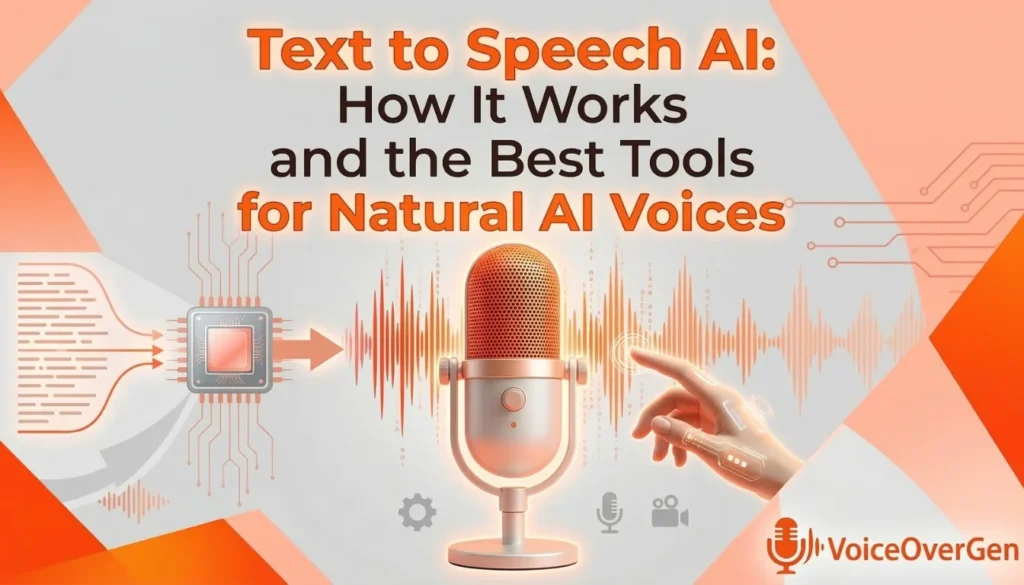
Artificial intelligence has quietly transformed how digital content is produced and consumed, and few technologies illustrate this shift better than Text to Speech AI. What once sounded robotic and mechanical has evolved into highly realistic synthetic voices capable of narrating videos, reading articles, powering virtual assistants, and even replicating human speaking styles.
Today, AI powered speech synthesis is used by YouTubers, educators, businesses, podcasters, and developers who need fast and scalable audio production. Instead of hiring voice actors or recording audio manually, creators can now generate natural sounding speech in seconds using AI models trained on massive datasets of human voices.
Text to Speech AI sits at the intersection of machine learning, linguistics, and audio engineering. Modern systems can understand context, control tone and pacing, and support dozens of languages and accents. As the technology matures, the line between human narration and synthetic voice continues to blur. Understanding how this technology works and which tools lead the market can help creators and businesses adopt AI voice solutions more effectively.
What Is Text to Speech AI
Text to Speech AI, often abbreviated as TTS, is a technology that converts written text into spoken audio using artificial intelligence models. Traditional text to speech systems existed for decades, but early versions relied on rule based phonetic systems and concatenated audio fragments. The result was speech that sounded stiff and unnatural.
Modern AI based TTS systems rely on deep learning models trained on thousands of hours of recorded human speech. These models learn patterns such as pronunciation, rhythm, emotional tone, and natural pauses. When a user enters text, the model predicts how a human would speak those words and generates a corresponding audio waveform.
The difference is immediately noticeable. AI voices today can emphasize words, pause at the right moments, and adjust speaking style depending on context. Some systems even allow users to generate custom voices or clone a real person’s voice with limited training data.
Because of these improvements, text to speech AI has become a core tool across industries including media production, accessibility technology, education, customer service automation, and marketing content creation.
How Text to Speech AI Technology Works
Modern text to speech platforms rely on a pipeline of machine learning components that transform written language into audio signals. While the process happens almost instantly for the user, several sophisticated steps occur behind the scenes.
1. Text Processing and Linguistic Analysis
The first stage converts raw text into a structured representation. The system identifies punctuation, sentence boundaries, abbreviations, and numbers. It also determines how words should be pronounced by converting them into phonemes, which are the basic sound units of language.
For example, the word “read” may be pronounced differently depending on the sentence context. AI language models help determine the correct pronunciation based on surrounding words.
2. Acoustic Modeling
Once the system understands the text linguistically, it generates acoustic features that describe how the voice should sound. Deep neural networks predict elements such as pitch, duration, rhythm, and stress patterns. Modern models like Tacotron style architectures or transformer based speech models excel at producing natural prosody that mimics human speech.
3. Audio Waveform Generation
The final step converts the acoustic features into an actual sound waveform. Neural vocoders such as WaveNet, HiFi-GAN, or similar architectures generate the audio signal that becomes the final voice output.
This stage is responsible for much of the realism. Advanced neural vocoders reproduce subtle characteristics like breath sounds, tonal variations, and natural speech dynamics.
Key Features of Modern AI Text to Speech Tools
Modern text to speech platforms include far more than simple narration capabilities. The most advanced systems offer powerful customization and production tools.
Natural sounding voices remain the primary feature. High quality models produce speech that closely resembles professional voice actors.
Multiple languages and accents allow creators to produce global content without recording separate audio tracks.
Voice customization enables users to control pitch, speed, emotion, and speaking style.
Voice cloning technology allows businesses or creators to generate a digital version of a real voice.
Real time generation ensures audio can be produced instantly for applications like chatbots, interactive apps, or live systems.
API integrations allow developers to integrate AI voices into apps, games, websites, and SaaS platforms.
Best Text to Speech AI Tools for Natural Voices
The AI voice ecosystem has expanded rapidly in recent years. Several platforms now offer high quality speech synthesis for creators, developers, and businesses.
Amazon Polly
Amazon Polly is part of the AWS ecosystem and is widely used by developers building scalable voice applications. It offers dozens of languages, neural voices, and a reliable API for enterprise applications. Many apps and digital services rely on Polly because of its stability and cloud integration.
ElevenLabs
ElevenLabs has quickly gained popularity for producing extremely natural sounding AI voices. Its models focus heavily on expressive speech, emotional tone, and voice cloning. The platform is commonly used for YouTube narration, audiobooks, storytelling content, and character voices.
Google Cloud Text to Speech
Google’s AI voice platform uses deep neural networks trained on large speech datasets. It supports many languages and integrates easily with Google Cloud infrastructure. Developers often choose it for conversational AI systems, mobile apps, and accessibility features.
Microsoft Azure AI Speech
Microsoft Azure Speech provides advanced neural voices and enterprise grade speech APIs. Businesses use it for call center automation, AI assistants, translation systems, and voice enabled applications.
PlayHT
PlayHT focuses on creator friendly voice generation tools, including realistic voices, voice cloning, and podcast narration capabilities. Many bloggers and content creators use the platform to convert articles into audio versions.
VoiceOverGen
VoiceOverGen is another platform in the AI voice ecosystem designed for creators, marketers, and businesses that need fast text to speech generation. It focuses on producing natural voiceovers for videos, online courses, and digital content. Tools like VoiceOverGen simplify the workflow for users who want to generate narration without complex audio production steps.
For example, a YouTube creator producing tutorial videos can quickly convert scripts into voiceovers using an AI platform rather than recording audio manually. This type of workflow is becoming increasingly common in modern content production.
Real World Use Cases for Text to Speech AI
Text to speech AI is no longer limited to accessibility tools. Its applications now span many industries and creative workflows.
Content Creation and YouTube Videos
Many YouTubers use AI voice tools to narrate explainer videos, tutorials, and documentary style content. AI voices allow creators to produce videos faster and maintain consistent audio quality.
Podcast Production
Podcasters increasingly experiment with AI narration for scripted content, summaries, and automated segments.
E Learning and Online Courses
Educational platforms use text to speech to produce course narration in multiple languages. This allows instructors to scale their content globally without recording separate voice tracks.
Marketing and Advertising
Businesses use AI voices to generate product videos, ad narration, and promotional audio content.
Accessibility Technology
Perhaps the most important use case remains accessibility. AI speech helps visually impaired users access written content, websites, and digital documents.
Customer Support Automation
AI powered voice assistants and call center systems rely heavily on text to speech to communicate with customers.
Challenges and Limitations of AI Voice Technology
Despite its rapid progress, text to speech AI still faces several limitations.
One challenge is emotional nuance. While modern models can simulate tone, replicating the full emotional range of a human actor remains difficult in complex storytelling contexts.
Another concern is ethical voice cloning. The ability to replicate someone’s voice raises questions about consent and misuse. Many companies now implement safeguards such as voice verification and permission requirements.
Latency can also be a concern in real time applications. Generating high quality speech requires significant computational resources, although new model architectures continue to improve performance.
Future Trends in AI Text to Speech
The next generation of text to speech technology will likely focus on realism, personalization, and interactivity.
Speech models are increasingly integrating with large language models, allowing AI systems to generate both the script and the voice output in a unified workflow. Real time conversational voices are also improving rapidly, which will make AI assistants sound more natural and responsive.
Another emerging trend is personalized voice avatars. Users may soon create fully customizable digital voices that represent them across platforms, games, virtual worlds, and communication tools.
For creators and businesses, this means voice production will become faster, cheaper, and more flexible than traditional recording methods.
Conclusion
Text to Speech AI has evolved from a niche accessibility technology into a powerful tool for modern digital communication. Advances in neural speech synthesis have made AI generated voices more realistic, expressive, and versatile than ever before.
From YouTube videos and podcasts to customer service automation and educational content, text to speech systems now play a central role in how audio content is produced. As models continue to improve, the gap between human narration and AI generated speech will continue to shrink.
For creators, developers, and businesses exploring scalable audio production, AI voice technology offers a practical and increasingly sophisticated solution.