
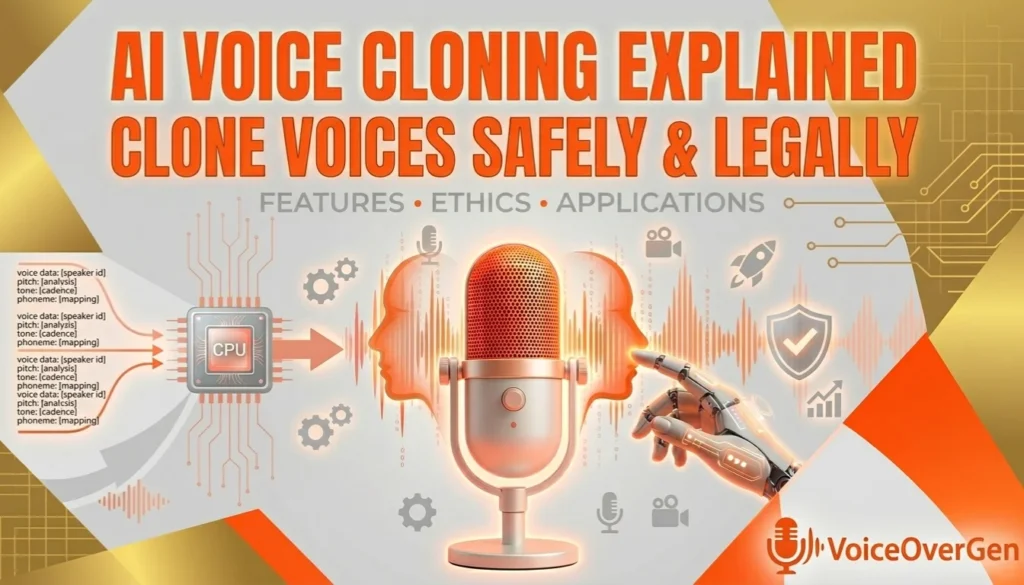
Artificial intelligence is rapidly changing how audio content is produced. One of the most powerful innovations in this space is AI voice cloning, a technology that can replicate a person’s voice with impressive realism. Instead of recording new audio every time, creators and businesses can generate speech that sounds like the original speaker using AI.
This capability is built on modern neural text to speech systems and advanced machine learning models that analyze vocal patterns such as pitch, tone, cadence, and pronunciation. With enough training data, AI can recreate a voice and generate entirely new speech that the original speaker never recorded.
For content creators, marketers, educators, and SaaS companies, voice cloning unlocks major efficiency gains. Video creators can generate voiceovers instantly, podcast editors can fix mistakes without re-recording, and businesses can scale multilingual content production. However, because voices are tied to personal identity, voice cloning must be used responsibly and within legal boundaries.
In this guide, we will explain how AI voice cloning works, where it is used, how to use it safely, and which tools support voice cloning technology. We will also explore the ethical considerations that come with replicating human voices using AI.
What Is AI Voice Cloning
AI voice cloning is a type of speech synthesis technology that creates a digital replica of a human voice using machine learning. By analyzing recorded speech samples, the AI learns the unique acoustic patterns of a person’s voice and can generate new speech that sounds like them.
Unlike traditional text to speech systems that rely on generic voices, voice cloning creates a personalized voice model. Once trained, the system can convert any text into speech using the cloned voice.
Voice cloning typically exists in two forms.
| Voice Cloning Type | Description | Typical Use Cases |
|---|---|---|
| Instant Voice Cloning | Creates a rough voice replica using a small audio sample | Content creators, quick voiceovers |
| Professional Voice Cloning | Uses longer recordings and deeper training for high accuracy | Audiobooks, brand voice systems, enterprise voice assistants |
Most modern cloning systems are built on neural speech synthesis technology similar to the systems described in this detailed guide on AI text to speech technology.
How AI Voice Cloning Technology Works
AI voice cloning relies on deep learning models trained on large datasets of human speech. While different platforms use different architectures, most systems follow a similar pipeline.
1. Voice Data Collection
The first step is collecting speech recordings from the person whose voice will be cloned. These recordings help the AI learn pronunciation, vocal tone, pacing, and speech patterns.
Most systems require between one and thirty minutes of clean audio. Higher quality recordings produce better results.
Creators who want to understand how voice generation works more broadly can explore this overview of AI voice generators and their underlying technology.
2. Voice Feature Extraction
Machine learning models analyze the audio and convert it into numerical features. These features represent aspects such as pitch curves, timbre, and phoneme transitions.
These extracted features allow the AI to understand how a voice behaves across different words and emotional expressions.
3. Neural Voice Modeling
Deep neural networks then train on the extracted features. Modern speech synthesis often uses transformer based models or diffusion based audio models that can generate highly natural speech.
This process essentially teaches the AI how the voice would pronounce any possible sentence.
4. Speech Generation
Once the model is trained, the AI can generate new speech from text input. The system predicts how the cloned voice would articulate each word and produces the corresponding audio waveform.
Many platforms combine cloning technology with advanced text to speech AI systems to generate natural voiceovers for videos, podcasts, and applications.
Key Features of Modern AI Voice Cloning Tools
Recent advances in AI speech models have significantly improved the realism and flexibility of voice cloning tools.
| Feature | Description | Benefit |
|---|---|---|
| High Realism | Neural speech models replicate subtle vocal traits | Voices sound nearly identical to the original speaker |
| Multilingual Generation | Cloned voices can speak multiple languages | Enables global content localization |
| Emotion Control | Users can adjust tone, pacing, and emphasis | More expressive voiceovers |
| Fast Inference | Speech generation occurs within seconds | Ideal for real time applications |
| API Integration | Developers can integrate voice generation into software | Useful for SaaS platforms and apps |
Many of these capabilities are also present in modern AI speech generator platforms designed for scalable audio creation.
Real World Applications of AI Voice Cloning
Voice cloning technology is being adopted across multiple industries that rely on audio communication.
Content Creation and YouTube
Video creators can generate voiceovers without recording every script. This dramatically speeds up production and allows creators to update videos quickly.
Many YouTubers rely on modern text to voice AI tools that combine cloning and speech generation to produce professional narration.
Podcasts and Audiobooks
Podcast editors can fix mistakes without re-recording entire segments. Audiobook publishers can also generate narration faster using AI voice models.
Marketing and Advertising
Brands can maintain a consistent brand voice across advertisements, product videos, and social media campaigns.
Companies that want to experiment with AI narration often start with a free AI voice generator before moving to professional voice models.
Gaming and Interactive Media
Game developers can create thousands of dynamic dialogue lines without recording each line manually. AI voices can also adapt to player interactions in real time.
Accessibility and Assistive Technology
Voice cloning has life changing potential for individuals who may lose the ability to speak due to illness or injury. By recording their voice early, they can continue communicating using a digital version of their own voice.
Popular AI Voice Cloning Platforms
Several platforms offer AI voice cloning or advanced speech generation capabilities. The table below highlights some widely used options.
| Platform | Key Strength | Typical Users |
|---|---|---|
| Descript Overdub | Podcast editing and voice correction | Podcasters, video creators |
| ElevenLabs | Highly realistic voice cloning | Creators, game developers |
| PlayHT | API driven voice generation | Developers and SaaS platforms |
| Resemble AI | Enterprise voice cloning solutions | Businesses and AI assistants |
| VoiceOverGen | Simple AI voice generation for creators and marketers | Content creators, businesses |
Platforms like VoiceOverGen combine voice cloning with flexible AI voice text to speech tools, making it easier for creators to generate voiceovers without complex audio production workflows.
For users exploring multiple platforms, this curated list of free AI voice generator tools provides a broader comparison of available solutions.
Legal and Ethical Considerations of Voice Cloning
Voice cloning technology must be used responsibly. Because a voice is closely tied to identity, unauthorized replication can lead to legal issues.
Consent and Voice Ownership
Always obtain explicit permission before cloning someone’s voice. Many countries recognize voice likeness as part of a person’s identity rights.
Deepfake and Impersonation Risks
AI generated voices could potentially be misused for impersonation or misinformation. Responsible platforms implement verification systems and usage policies to reduce abuse.
Copyright and Licensing
If voice actors contribute recordings to train AI models, contracts should clearly define ownership rights and compensation.
Platform Policies
Many AI voice companies prohibit cloning public figures, celebrities, or private individuals without consent.
Best Practices for Safe AI Voice Cloning
Using voice cloning responsibly requires a few simple guidelines.
Always obtain clear consent before cloning a voice. Use high quality recordings so the AI accurately represents the speaker. Be transparent when publishing AI generated audio and disclose when synthetic voices are used.
Creators who want to explore safe voice generation workflows can experiment with modern voice AI generator platforms that include built in safeguards.
Future Trends in AI Voice Cloning
Voice cloning technology is evolving rapidly as AI speech models improve.
Real time voice cloning is becoming more feasible, allowing AI to replicate voices during live conversations. Multilingual voice transfer is improving, enabling voices to speak multiple languages while maintaining their original tone. Emotional speech synthesis is also advancing, producing more expressive and natural sounding voices.
At the same time, governments and technology companies are developing new policies and detection systems to identify synthetic media and prevent misuse.
Conclusion
AI voice cloning represents one of the most significant breakthroughs in modern speech technology. By combining machine learning with advanced neural speech synthesis, AI systems can recreate human voices with remarkable realism.
For creators, businesses, and developers, this technology reduces the time and cost required to produce professional voice content. It enables scalable narration, personalized audio experiences, and entirely new forms of digital storytelling.
However, voice cloning must be used ethically and with proper consent. When applied responsibly, it can expand accessibility, creativity, and communication across industries.
As AI speech technology continues to improve, voice cloning will likely become a standard tool for media production, marketing, education, and software development.
For readers who want to explore more tools and use cases, this guide to the best AI text to speech tools for creators and businesses offers additional insights into the rapidly growing AI voice ecosystem.